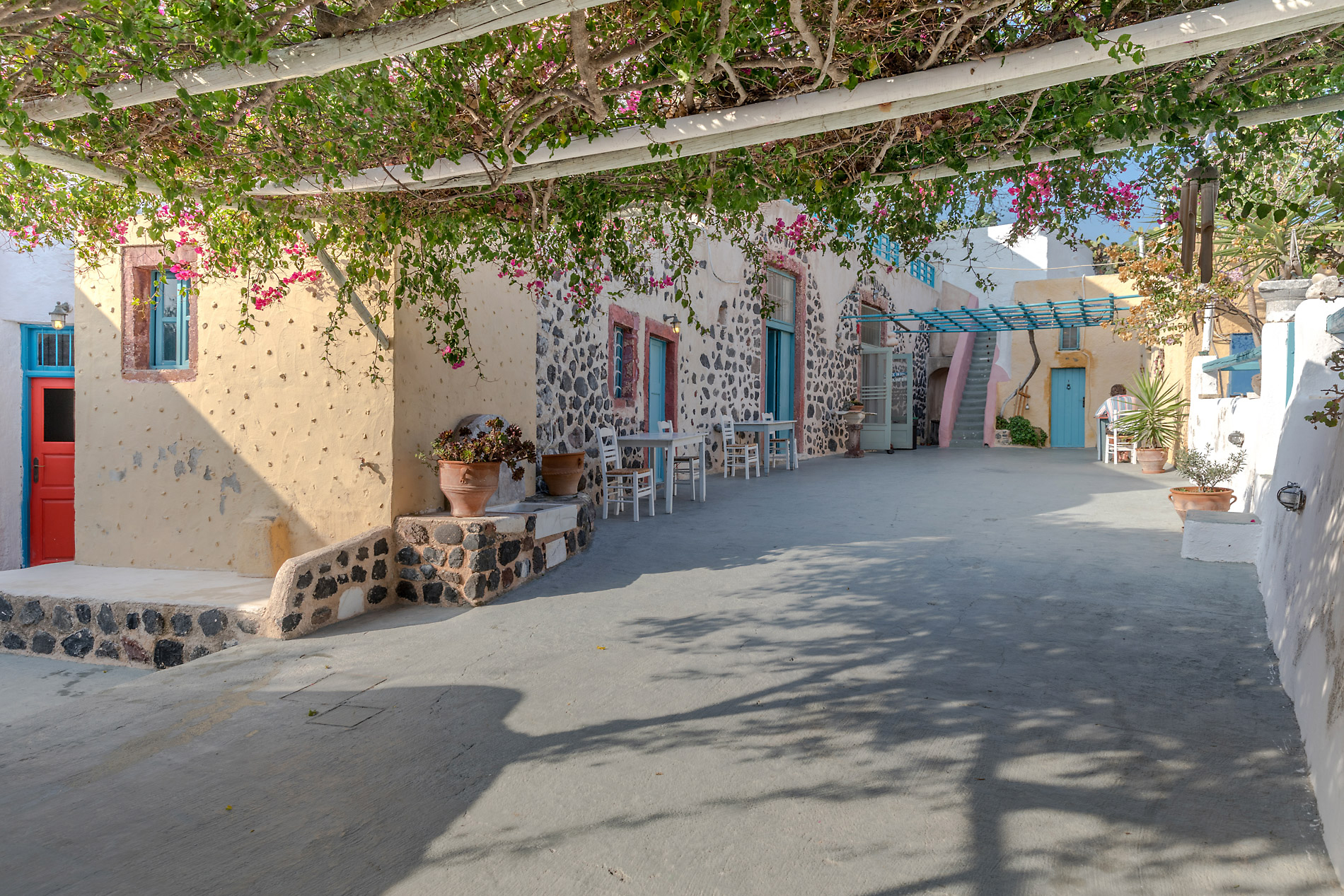
Staying at Caveland means choosing to stay in a piece of history
Staying at Caveland means immersing yourself in a piece of rich history at a beautiful Santorini cave hostel.
From wine-estate to hostel
Did you know that 250 years ago this site was not a hostel but a traditional wine-producing estate? The vast complex that today houses our hostel once stood amid nothing but fields of grapevines. At our Santorini cave hostel you literally sleep in authentic, wine-era caves carved into volcanic pumice stone.
The signature vineyards of Santorini
Wine production remains one of Santorini’s defining features. The vineyards are sometimes referred to as a “Jurassic park of wine” because their remote island location and unique volcanic soils have spared them from many pests and common wine diseases. This means the wines you taste today carry something of that ancient essence — an elemental flavour shaped by time.
At our Santorini cave hostel, you will feel that connection to island heritage.
Arriving at Caveland – you’ll feel it
From the moment you arrive at our reception area, you feel transported to another era. In front of the desk sits a small well: today it holds local pumice stone; in its past it once held mashed grapes.
The tour continues as you walk into the guest rooms.
- Some of our large caves — now used as a 6-bed or a 4-bed ensuite dorm — once stored wine.
- The rooms directly across from reception are built as outside extensions of long caves: originally they were the owners’ and staff’s quarters.
- Our upper courtyard includes caves that once housed local animals (yes, donkeys!).
- If you stay in the 2-bedroom apartment, you’ll note it used to serve as the winery office and still retains original flooring and a closet.
Staying in our Santorini cave hostel means you very literally sleep within history.
How the caves were made and why
These caves are man-made, carved directly into volcanic pumice. Because we are on a volcanic island, digging into the rock offered both natural insulation and stability. Our caves stay cool in the summer and warm in the winter — ideal for comfort. They also endure mild tremors better than many surface-structures. At this unique Santorini cave hostel, you rest well knowing you’re in rock that’s been strong for centuries.
The island’s white-washed tradition
White dominates the island and our walls. Each spring, after the winter rains, we whitewash our outer walls. In the past, whitewashing served antiseptic purposes (especially during cholera outbreaks in the 1920s) and repelled pests — important in an era when donkeys were the main transport. White reflects the sun and simply makes everything look brighter, cleaner and smoother. At our Santorini cave hostel, you see that crisp white island aesthetic everywhere.
Wine heritage meets export history
The wine of Santorini has long held fame — it was shipped as far as Venice and Odessa. The island’s fortified wine travelled well by sea. Our little winery in this very estate once held connections for export to Alexandria, Egypt. When you stay at this Santorini cave hostel, you are literally staying in the building that once formed part of that global wine-trade story.
Rare architecture under heritage protection
Today few properties on Santorini still represent this local architecture — and we’re proud that Caveland is one of them. The entire complex lies under heritage protection, so only a few features can change. You will notice heavy gates to the dorms, doors with complicated locking systems, windows with wooden blinds, and rooms with an extra upper “patari” floor (an old mezzanine). Choose our Santorini cave hostel and you choose architecture that remembers its past.
A hostel with a unique character
The unique character of Caveland draws attention from media. In 2013 a crew from HGTV (from Texas) filmed here for their “You Like In What” show. We regularly appear on lists of the world’s most unique hostels. When you stay at our Santorini cave hostel, you’re staying somewhere with story, soul and distinction.